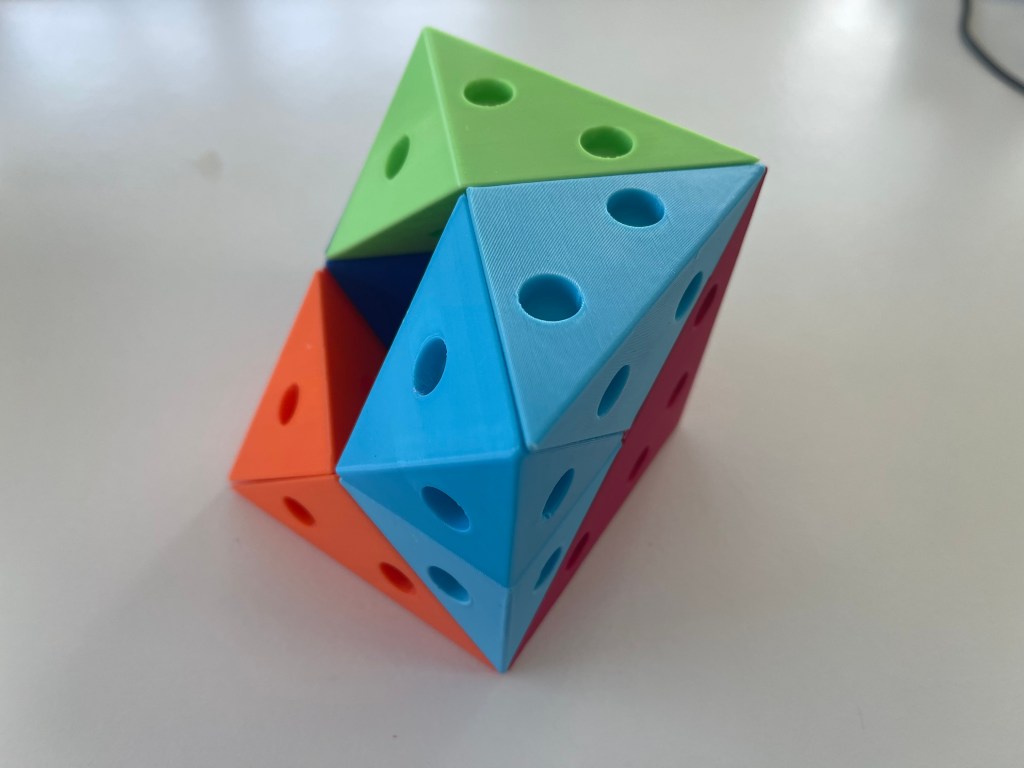
Abies

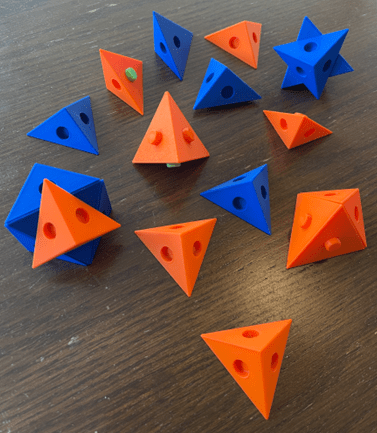
… a collection of Abies in every family home …

  • There are rules for making constructions with Abies, but there are no serious consequences if you break them. In fact, many of the best structures are made by breaking them. As in society, however, there are some consequences when you break the rules.

    Whether you like rules or not, it is good at least to know them. Here are the rules we followed when making larger Abies out of Abi-C’s and Abi-D’s. (Remember that an Abi-C has four identical faces and an Abi-C has three identical but smaller faces with the fourth one being the same as a face of an Abi-C, you can see this in number 01 of this blog).

    Rule 1: an Abi-C may only be connected to the large face of an Abi-D. So, it may not be connected to one of the smaller faces of the Abi-D. This also means that it is not permitted to connect two Abi-C’s together.

    Rule 2: two Abi-D’s may only be connected to each other with one of their three smaller faces. So, they may not be connected to each other with their large face.

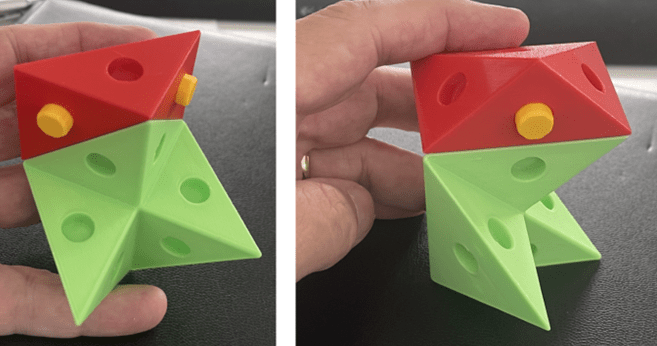
    Here I will later post some pictures of the connections that can be made breaking these rules. I have lent out my complete collection of Abies, so I cannot do this right now.

    Rule 3: connecting faces have to cover each other. So, you may not rotate one of them relative to the other.

    This little bird was made breaking all of these rules.
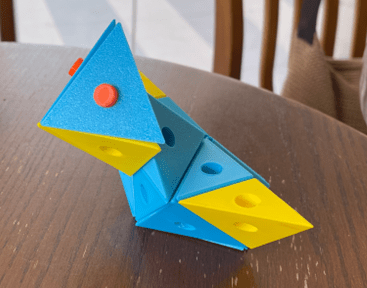
    This construction was made abiding by all the rules.
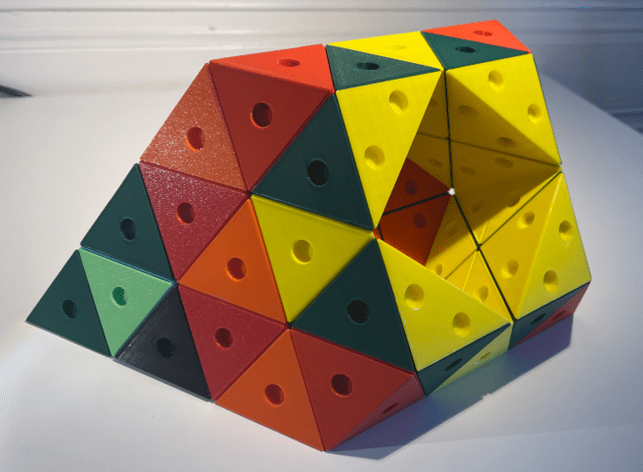
    The rules also apply to larger Abies. To comply with them you need to remember if a peghole originally belonged to a small face of an Abi-D; to the large face of an Abi-D; or to one of the faces of an Abi-C. For larger constructions this is not always easy. For example: of the three dark-green triangles on the left and the one light-green triangle, can you say which belong to an Abi-C and which to an Abi-D? Here is the answer: the dark green triangles belong to an Abi-C, and therefore may only be connected to an Abi-D. The light green triangle belongs to an Abi-D and since it is its large face it may therefore only be connected to an Abi-C. Don’t worry about it, you can enjoy playing with Abies without having all this in your head.

    In general one can say that you can make larger structures when abiding by the rules and at the end you can further beautify them by breaking the rules. I will look for a nice example of that and also post it here later.
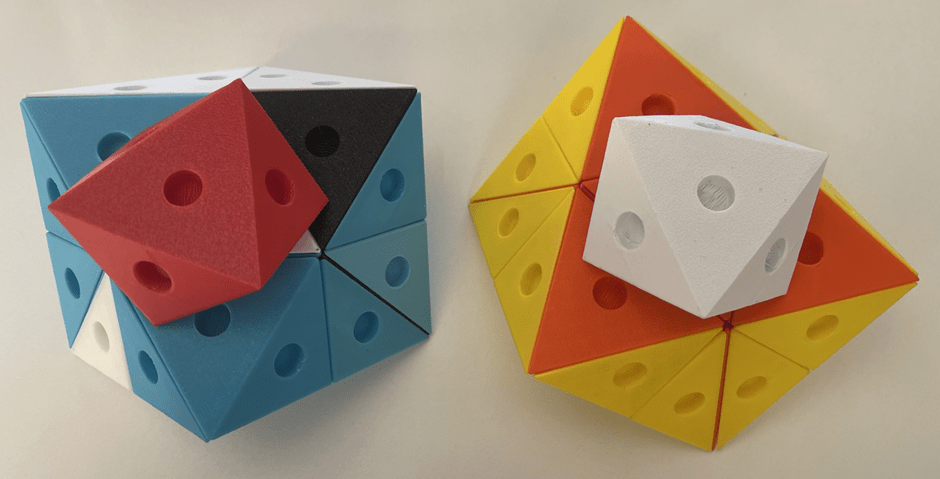
  • The Hicks Abi is special. You can see some Hicks Abies below. There are two small ones (red and white) and two large ones (blue-white-black and yellow-orange).

    You cannot make the small Hicks Abi from Gen1 Abies, but it is possible to make the larger Hicks Abies from Abi-C’s and Abi-D’s.

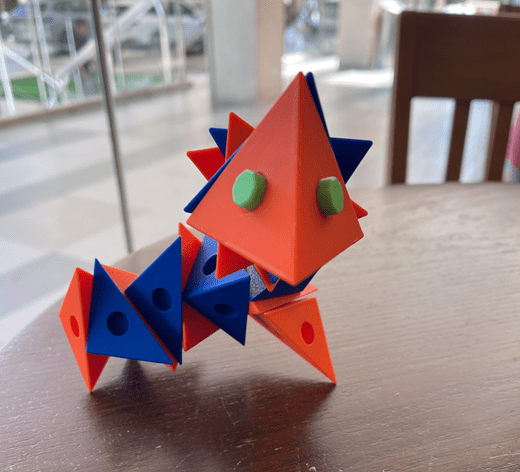
    Adding the Hicks Abi to the Abi family adds a range of new possibilities, making Abies all the more exciting. We thought this one (below) looks a bit like those little colorful frogs that you find in the rainforest. Its head is made with a Hicks Abi.

    When we discovered the Hicks Abi we decided to add it to the family of Abies, perhaps call it Abi-E, and we thought it might be the last addition that would have  a life as a standalone Abi (but we discovered even more after that). That is why we named it after ‘the Higgs’.

    After playing with Abies for many hours we now consider ourselves experts in having fun with Abies and in making all kinds of wonderful structures, but the first time, after we had accidentally discovered the Hicks Abi, it took us about a day to figure out how to make a larger Hicks Abi from Gen1 Abies.

  • Many Abies can be turned into some kind of creature just by giving them eyes. This is already possible with the smallest Abies. It turns them into some kind of tiny mice that squirrel around on the floor.

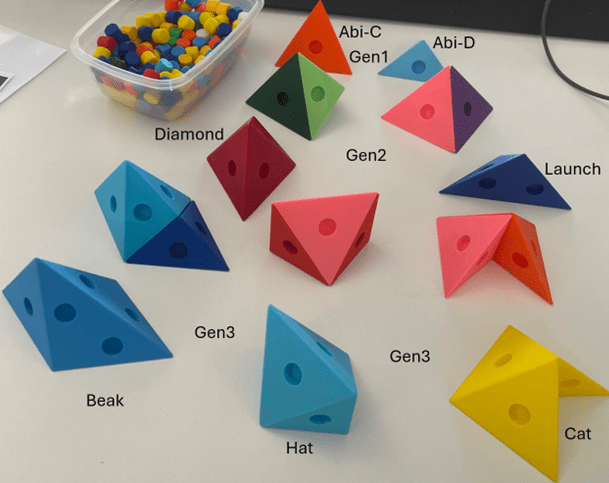
    The Beak on the left and the Cat bottom right are still looking for a body.

  • Abies come in ‘Generations’. You already know the first generation: Gen1. It contains only the two ‘primordial’ Abies: Abi-C and Abi-D (they were introduced in entry number 01 of this blog).

    Gen2 contains Abies that can be made from two of the Gen1 Abies. There are two Gen2 Abies: Diamond and Launch.

    Likewise Gen3 contains Abies that can be made from three Abies of Gen1. This means that they can also be made from one of the Gen2 Abies plus one of the Gen1 Abies. And so it goes on. The generation number tells you how many of the primordial Abies Abi-C and Abi-D you need to make an Abi of the same shape.

    To give you a heads-up: there are 12 Gen4 Abies and 34 Gen5 Abies. We did not make them all as single pieces (yet). In case you are curious: the large Abi in entry 02 of this blog would be a Gen25 Abi. It is unlikely that we will make Abies as large as that in the form of a single Abi.

    Note: we use some rules to define these generations, starting from Gen1. You do not need to know those rules, but for those who are interested we will explain them in a later blog.

  • In their most common version Abies come with pegs, and they have pegholes in their sides. If you insert a peg into a peghole you can connect Abies together.

    This creature was made using pegs.

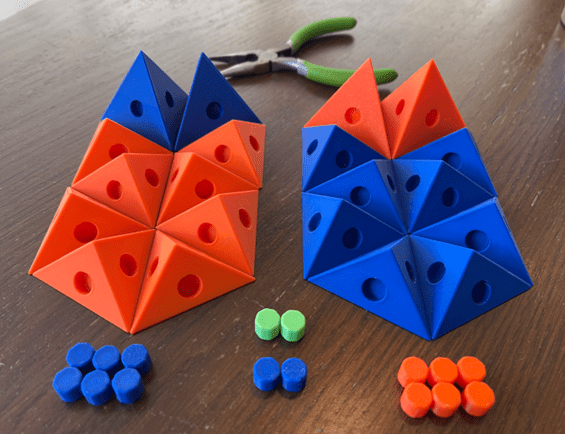
    Below is a basic set of Abies. The plan is to start selling these in October-November 2025. A set like this will cost 1,590 PHP (about 24 EUR). We still need to add VAT, and possibly Tariffs. We worked out this is what we need to keep the business alive and grow it. For some families this may be quite a bit of money, and therefore our goals are 1) to make Abies cheaper while keeping the quality as good as it is now, and 2) making Abies better without making them more expensive.

    A basic set contains four Abi-C’s and sixteen Abi-D’s, as well as sixteen pegs.

    Note the small plier in the background. It is used to remove pegs when they, and the Abies they connect, are needed for another construction. You will rarely make a construction with Abies to put it on the shelf and leave it there for a long time. Maybe tomorrow you make a new construction and need the bricks you used for the construction you made yesterday: so you need a peg remover. This works very well for now, but we are working on a better way to remove pegs. For now, children who are still too young to use a plier will need the help from an adult to remove the pegs. Many families will have such a plier at home and it is therefore not included in the set.

    An Abi brick is likely to be used many times, in many different constructions. Abies inspire creativity. You do not make constructions following a manual. Often you end up making something beautiful that has never been made before. Take a picture of it, so that you remember how to make it before you take it apart again.

  • By putting together Abies you make new Abies. When they get big they are called constructions. In this blog you will first see smaller Abies, but to get some idea of what is possible here is a large Abi.

  • Here you see one Abi-C (the blue one), one Abi-D (the green one) and a combination of one Abi-C (orange) and one Abi-D (yellow).

    There are many Abies. You will see more of them soon. (note: Abies rhymes with ‘babies’)